
Toyota on January 20, 2026, officially entered India's mass electric vehicle segment with the maiden launch of the Toyota Urban Cruiser Ebella in Mumbai.

Toyota's first standalone electric SUV, the Urban Cruiser Ebella, delivers strong range and performance with premium quality, but rear space and features could have been better, says Somnath Chatterjee.
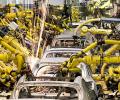
Passenger vehicle sales in India reached a record high of 4.7 million units in FY26, boosted by strong performances from major automakers and the implementation of GST 2.0.

Leading automakers in India, including Maruti Suzuki, Tata Motors, Mahindra & Mahindra, and Hyundai, reported increased vehicle dispatches to dealers in February, driven by sustained domestic demand.
Leading automakers in India, including Maruti Suzuki, Tata Motors, Mahindra & Mahindra, and Hyundai, reported increased vehicle dispatches to dealers in February, driven by sustained domestic demand.

JSW MG Motor India will launch four new models this year, and is planning to invest between 3,000 crore-4,000 crore in the country over the next couple of years. The new models include a plug-in hybrid, an electric vehicle, the Majestor SUV and one additional model yet to be disclosed.

The LPG squeeze on India's restaurant sector is the quotidian face of a deeper crisis.
Leading automakers Maruti Suzuki, Tata Motors, Mahindra & Mahindra, and Hyundai Motor India posted higher sales in January riding on the growth momentum ushered in by the GST reforms in the festive period last year.

The BJP has criticised Congress leader Rahul Gandhi for his explanation of decentralisation using a car and motorcycle engine analogy at a university in Colombia.

'In terms of semiconductors, challenges do remain in the pan industry, but I think we are much better than where we were a year or so back.'

Puligilla-Sherif becomes first Indian pair to finish on WRC3 podium

After a record-breaking year, India's automobile industry is entering 2026 on a relatively strong footing, with sales growth expected in the 6-8 per cent range. The outlook is underpinned by policy support, including GST rationalisation, easing monetary conditions, and income tax relief, which together are likely to improve affordability and sustain consumer demand across vehicle segments.

Starting January, the market is expected to welcome models like the Tata Punch 2025 which is expected to be around 6 lakh, Mahindra BE 07 EV around 29 lakh, Maruti WagonR Electric around 8.5 lakh, Toyota 3-Row SUV around 14 lakh, and Volkswagen Tera to be around 8 lakh.
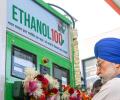
As of now, no firm has launched a flex-fuel vehicle in India, as these models are more expensive than comparable petrol-run vehicles.

Three additional vehicle makers and five more auto component makers will begin availing financial incentives under the production-linked incentive (PLI) scheme for the automobile sector from 2026-27 (FY27) onwards, Hanif Qureshi, additional secretary at the Ministry of Heavy Industries (MHI), said on Wednesday.

A deep split has emerged within India's auto industry over the proposed CAFE exemption for small cars, with only Maruti Suzuki and Renault backing the move in the final SIAM vote.

'The market is still very bullish. The demand is so strong that for eight models, we have no units in our factories to dispatch to dealers,' said Partho Banerjee, senior executive officer, marketing & sales, Maruti Suzuki India (MSIL).

With demand continuing to be strong post the festive season, leading automakers, Maruti Suzuki, Tata Motors and Mahindra & Mahindra, saw robust growth in sales in November as compared to the same month last year. Maruti Suzuki India reported the best-ever total sales, including exports, last month at 229,021 units, a year-on-year growth of 26 per cent as compared to November last year.
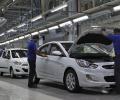
Top carmakers led by Maruti Suzuki, Mahindra & Mahindra, Tata Motors Passenger Vehicles and Kia India on Saturday reported record sales in the domestic market riding on festive demand boosted by GST rate cut. Other manufacturers such as Skoda Auto India and Toyota Kirloskar Motor also posted impressive growth in sales in October.
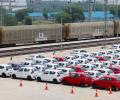
Companies with "gas guzzlers" are trying to set up the wrong narrative against small cars getting relaxation in the proposed corporate average fuel efficiency (CAFE-III) norms on the basis of weight, Maruti Suzuki senior executive officer corporate affairs Rahul Bharti said on Monday, bringing to the fore deep division among carmakers regarding the upcoming rules.

The recipe for Indian higher education institutions to succeed in the global markets is excellence in academics, promoting contemporary socially relevant material, and enabling individuals (learners) to realise their full potential, suggests N Ravichandran.

Stock market sentiment is likely to remain optimistic going ahead, though some consolidation cannot be ruled out after the recent sharp rally in the benchmarks, analysts said. According to experts, the Nifty and Sensex could indeed move towards new record highs before the end of the year, if global cues stay supportive, crude oil prices remain benign and there is continued domestic earnings momentum.

A 68-year-old Indian-origin businessman named Darshan Singh Sahsi was killed in Canada's Abbotsford on Monday morning, reported the Vancouver Sun.

EV manufacturers point out that converting a regular petrol car into a flex-fuel vehicle requires only about Rs 17,000-25,000 per unit, whereas developing an EV demands vastly greater investments in research, battery development, and localisation.

Maruti Suzuki, India's largest producer of small cars, stands to benefit the most.

Toyota on Thursday launched updated versions of its sedan Camry in India.
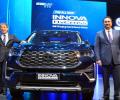
Grant Thornton Bharat's latest survey indicates that hybrids are set to consolidate market share this festive season, bridging the gap between conventional petrol engines and the emerging electric vehicle segment.

Amid slowing volume sales among India's major automakers, Toyota Kirloskar Motor (TKM) has defied the trend with strong growth, driven by demand for hybrid vehicles and a reliable product line up. The company expects this momentum to continue in 2025. "The overall response to our cars has been fabulous. So, we foresee the same momentum in 2025 as well," Sabari Manohar, vice-president, sales-service-used car business, TKM, said.

Japan is expected to increase its investment target in India from the earlier 5 trillion yen ($34 billion) to almost 10 trillion yen.

Electric vehicle (EV) manufacturers breathed a sigh of relief after the GST Council on Wednesday night retained the concessional 5 per cent rate on EVs, though they now face competition from small petrol and diesel cars, which will attract a lower 18 per cent levy.

After a successful tie up in traditional ICE and strong hybrid models, Suzuki and Toyota are now set to take their partnership to the next level: the electric vehicle segment. Both the Japanese auto giants recently announced a plan to produce Suzuki eVX-based SUV which will be sold under Toyota brand across the globe. This electric SUV, bearing Toyota's logo, will go for production at Suzuki Motor Group (SMG) facility in Hansalpur, Gujarat beginning the spring of 2025, marking the first EV launch for both companies in India.

The GST Council on Wednesday approved two slabs of 5 per cent and 18 per cent effective from September 22, the first day of Navaratri.

'I realised why the farmers and the rural folks are going for Trump. They are so insecure and vulnerable that anybody who is throwing a line of hope to them, they seize it.'
Auto majors Maruti Suzuki, Tata Motors and Mahindra & Mahindra reported robust sales in September as reduced price tags owing to GST rationalisation led to record demand in the Navaratri period. The month also saw Tata Motors and Mahindra & Mahindra settling at number two and three positions, respectively in vehicle wholesales ahead of Hyundai Motor India.

Toyota Kirloskar Motor (TKM) has reported a consolidated net profit of Rs 4,787 crore for 2023-24 (FY24) - more than three times the earnings recorded the previous year. This growth can be attributed to robust demand for its vehicles, particularly hybrid models and cross-badged cars from the Toyota-Suzuki alliance.

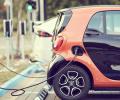
Despite the benefits of hybrid technology, a lack of government backing and few launches have kept the segment from gaining ground.
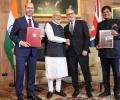
'That way you're not hostage just to US sort of exports to India.'

The only other company working on hydrogen cars in India is Toyota Kirloskar Motor.
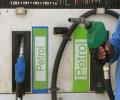
'The E20 usage accrues the huge benefit to the nation, to the society, to the farmer, to the environment, to the exchequer and all of us'
 © 2026 Rediff.com - Advertise with us - Disclaimer - Privacy Policy - Sitemap - Feedback - About us - Terms of use - Grievances